

My bank blocked me from buying Bitcoin, told me they couldn't unblock it, and then — in writing — suggested I find another bank. This is crypto debanking in Australia in April 2026, two weeks after the country passed its first comprehensive crypto legislation. I have the screenshots.
Before I get to the crypto blocking, context: I have a criminal record — drug charges from years ago, nothing violent. That's relevant because some of what happened to me has two causes, and I want to separate them honestly. Bank Australia closed my savings account before I'd deposited a cent — express-posted me a letter saying they'd reviewed my account and decided to cease my membership. I was refused by multiple brokerages too. Almost certainly my record. The crypto blocking is a different mechanism entirely, and it's the one hitting 30% of Australian crypto investors.
Up Bank blocked my Bitcoin purchases
I settled with Up, the neobank subsidiary of Bendigo and Adelaide Bank. For everyday banking, they've been fine.
Then I received an inheritance and decided I wanted to move a significant portion into Bitcoin. Not on impulse — I've been involved in crypto since 2011. I contacted Up ahead of time and told them exactly what I planned to do. They confirmed my test payment to Pepperstone Crypto had gone through. Green light.
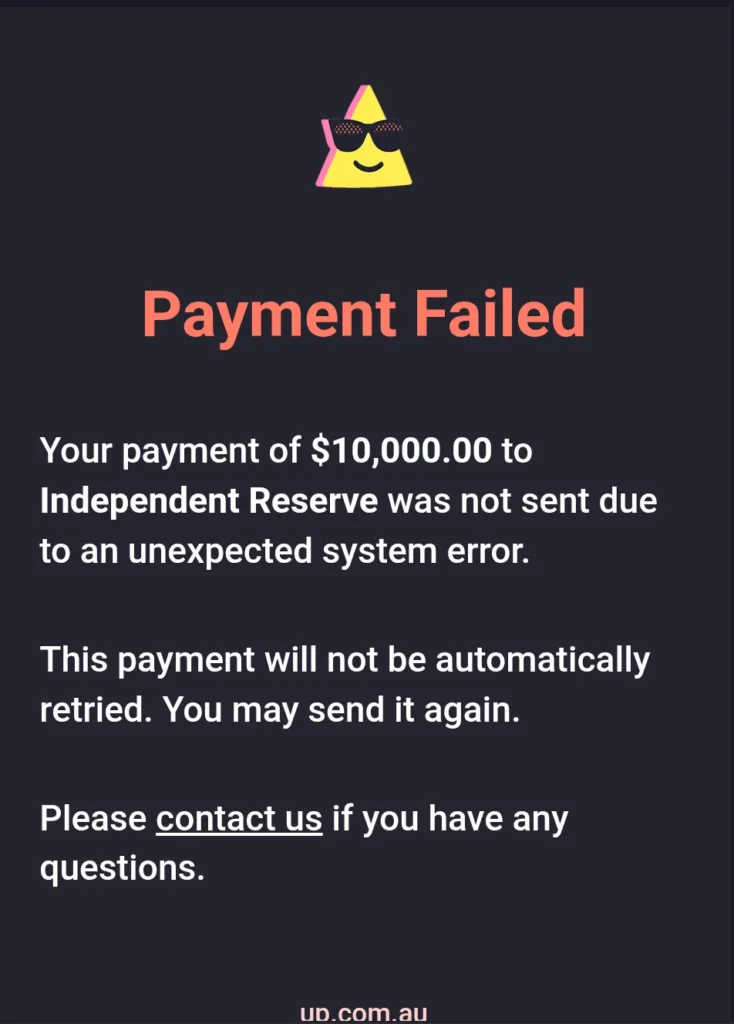
The larger payment failed. “Unexpected system error.” I tried again. Same error. I tried CoinJar. Same thing. Then Independent Reserve — I've got the email: “Your payment of $10,000.00 to Independent Reserve was not sent due to an unexpected system error.”
That's a strange way to spell “we blocked it.”
The support conversation
I contacted Up Support. What followed is documented in screenshots I'll never delete.
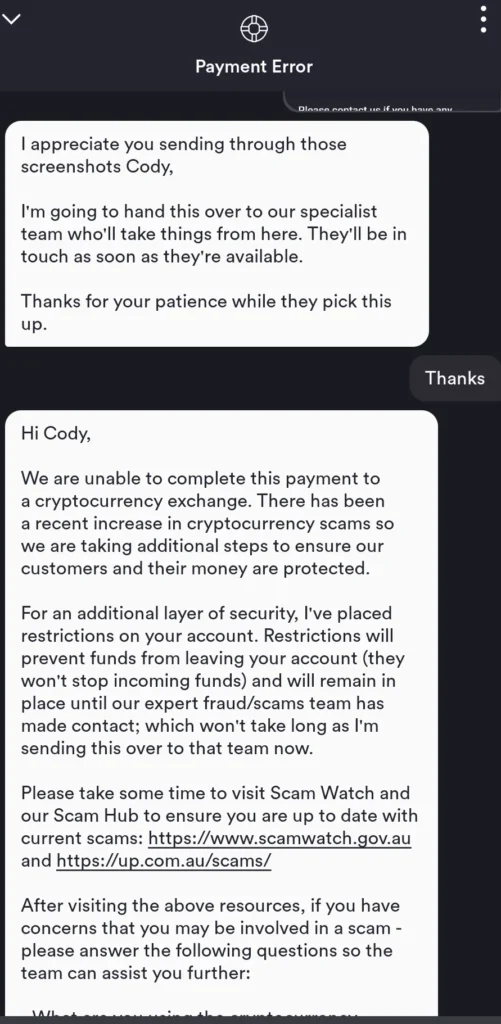
First, they froze my account — not just crypto, all outgoing funds. Their words: “I've placed restrictions on your account. Restrictions will prevent funds from leaving your account.” They directed me to Scam Watch and asked screening questions: what I was using the exchange for, whether someone had asked me to send the payment, how I'd found the “investment opportunity.”
I told them I was investing in Bitcoin. That I'd done my own research. That I'd called the exchange directly and verified it. That I'd completed a successful test payment. That I'd been in crypto since 2011 and understood the risks.
Their response: “We have completed a risk review on the attempted payments and we're not willing to unblock them in this instance.”
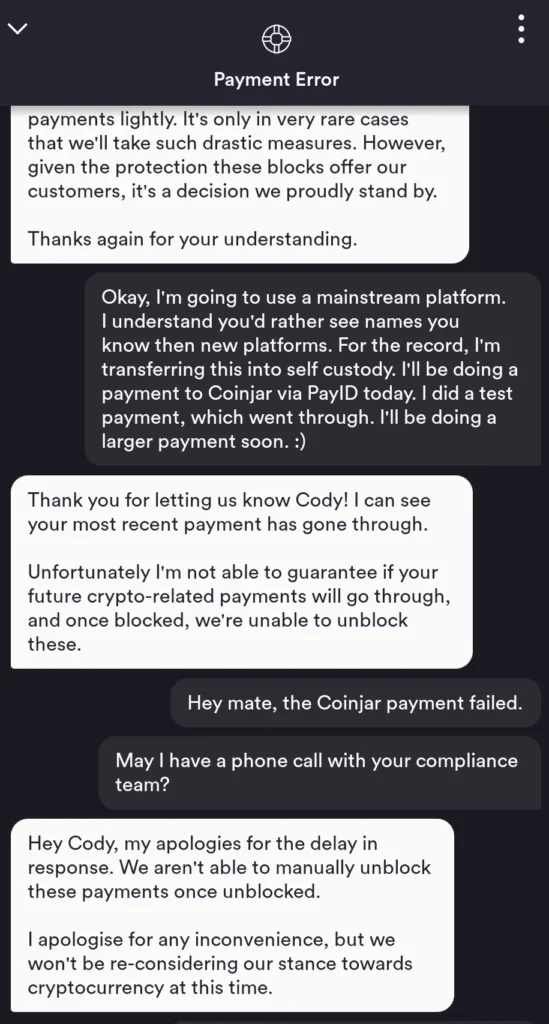
I asked about CoinJar OTC. They said they don't have a blanket ban on crypto, but “each payment to a cryptocurrency platform is assessed in real-time, on an individual basis.” They also said they're “unable to disclose the criteria which they are assessed against” and that “future payments to crypto platforms may or may not go through.”
Can't tell me why. Can't tell me which payments will be blocked next. Can't unblock the ones already blocked. But no blanket ban. Right.
I asked for a phone call with their compliance team. No.
I offered to sign a waiver. No.
Then came the line: “It could be worth reaching out to other banks to see if you can make crypto payments from their payment platform.”
My own bank. Holding my own money. Telling me to find another bank.
They closed with: “We won't be re-considering our stance towards cryptocurrency at this time.”
The quiet part out loud
Up's support agent was more honest than most when they wrote: “Due to its anonymity and irrevocable nature, the cryptocurrency exchange is one of the favourite weapons of scammers. For this reason, and because the entire Australian banking sector is at war with scammers, blocks on crypto payments will become more common.”
They're not saying I'm a scammer. They're saying crypto itself is the problem, and the blocks will get worse. From a bank that claims it doesn't have a blanket ban.
They also said — and I want to be precise — “it's a decision we proudly stand by.”
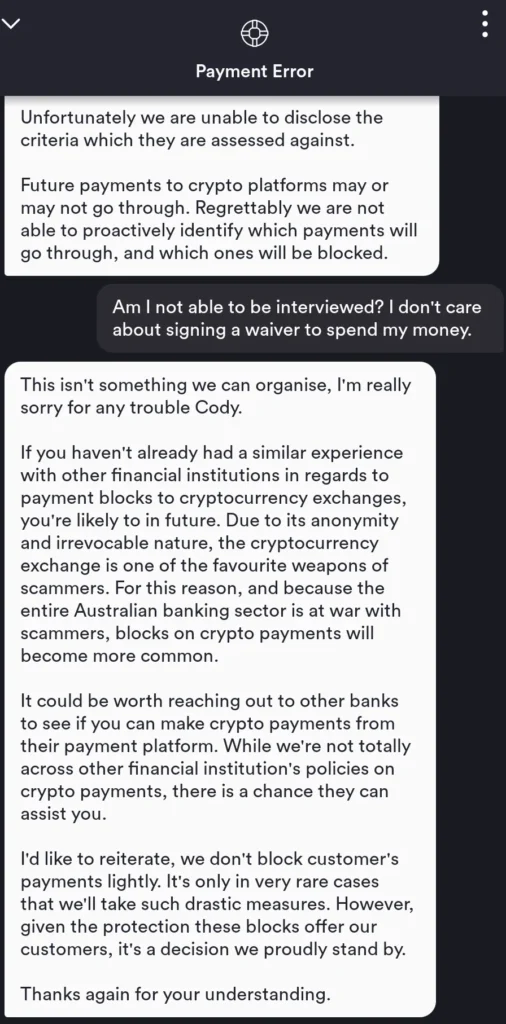
Proudly. They're proud of blocking a customer who contacted them in advance, verified the exchange, completed a test payment, explained his intent, has over a decade of crypto experience, and offered to sign a waiver.
Crypto debanking is hitting one in three Australians
The Independent Reserve Cryptocurrency Index 2026, published March 2026, found that 30% of Australian crypto investors have had bank payments blocked or delayed — up from roughly 20% the year before. Among 25–34-year-olds, it's 37%.
In February 2026, Coinbase told the Australian Parliament that debanking had become “a systemic feature of the Australian financial landscape.” Every major bank now caps crypto transfers at around $10,000 per month. Some enforce 24-hour holds. Others silently decline.
AUSTRAC has explicitly stated that the AML/CTF Act does not require banks to close accounts or block crypto transactions. The UNSW Centre for Law, Markets and Regulation reported that compliance sources called the AML/CTF regime “a convenient scapegoat for bank account closures due to unrelated compliance concerns.”
Banks are making a commercial decision to deny service, then dressing it in compliance language.
On 1 April 2026, the Corporations Amendment (Digital Assets Framework) Bill passed both houses. Exchanges must now hold Australian Financial Services Licences. Bank-grade compliance standards. Penalties up to $16.5 million.
Two weeks later, my bank is still blocking payments to AUSTRAC-registered exchanges and telling me to bank somewhere else.
What I did about it
I called Independent Reserve directly and told them what was happening. They said it's common enough that they've built relationships with smaller banks — newer accounts that don't sit on the major banks' automated block lists. I sent the transfer from Up to one of those accounts. It cleared without drama.
Up also eventually approved my first $10,000 direct transfer once their risk review wrapped up — one payment, after they'd already blocked three across three different exchanges.
Then the larger transfer came. Bendigo Bank — Up's parent — called me at 6pm and sternly demanded I call them back. What followed was an interview. They went through every previous blocked payment, asked the same scam-screening questions Up had asked, and the representative sounded reluctant and cagey throughout. She confirmed the destination bank account was verified as belonging to the company. She also said they couldn't promise that “no one from the company might scam me.”
Independent Reserve is AUSTRAC-registered. It's one of Australia's oldest exchanges. She was raising the possibility that a staff member inside a regulated business might personally scam a customer. Banks don't say this to people transferring six figures to Bell Potter or Morgans Financial. They reserve this framing exclusively for crypto.
The transfer went through. The Bitcoin is in cold storage, in a wallet I control, with keys nobody can freeze, block, or “risk review.”
Every time a bank blocks a legitimate transaction, they make the strongest possible case for self-custodial finance. Every “unexpected system error” is a pitch for Bitcoin's core value proposition: money that works without permission. Experiences like this are why I built The Privacy Technologist.
If this is happening to you
Document everything. Screenshots, emails, chat logs. Complain to your bank's internal dispute resolution team first — they have 30 days to respond. If unresolved, lodge with AFCA. You can also report it to the Banking Code Compliance Committee. Under the Banking Code, you're entitled to at least 30 days' notice before account closure.
Fair warning: AFCA's own guidance says they're unlikely to force a bank to reopen your account. No Australian regulator has ever penalised a bank for unjustified debanking. But getting it on the record matters. The more complaints they receive, the harder it gets to pretend this isn't a systemic problem.
Your money. Your choice. That shouldn't be a radical position.